A private label face serum offers a practical entry point for brands looking to launch a skincare product without building a formula from scratch. For founders, established brand owners, and distributors, the main challenge is finding a formula that fits the target market, budget, and sales strategy while keeping development costs and launch risks under control.
This 2027 guide explains how to evaluate liquid and freeze-dried serum options, compare factory MOQs, assess free sampling policies, and plan packaging and compliance requirements. It also covers active ingredient stability, supplier capabilities, and first-order timelines, helping buyers identify potential production risks and build a realistic launch plan before committing to a bulk order.
Key Takeaways
- A serum is the natural hero SKU: the highest active concentration and perceived value per milliliter, in a small format that empties fast and pulls repurchase forward.
- Liquid serum MOQ starts at 1,000 units for light customization; freeze-dried serum starts at 2,000 pairs. The two formats price and scale differently.
- Sampling is nearly free: about three bulk-formula samples, with the buyer paying only international freight, and standard samples ready in 15 working days.
- A serum’s real risk is deactivated actives. Vet encapsulation, freeze-drying, and segregated preservation — not just the ingredient list.
- Actives can be tuned to your claim and price point, including copper-peptide concentrations from 1% para 11%.
- Plan six to ten weeks from brief to EXW handover: free sampling, 50% deposit, 50% after inspection.
Why a Face Serum Is a High-Value First Product
Before comparing factories, it is worth being precise about why the serum — not a cream or cleanser — should carry the hero slot. The category’s economics do most of the arguing, and they hold across every market, from Europe and North America to Southeast Asia and the Middle East.
Premium Value and Repeat Purchase
A serum carries the highest concentration of actives in a routine, so it commands the highest perceived value per milliliter. The same logic sets the price ladder: buyers accept premium pricing on a 30 ml dropper they would question on a larger format, which is why serums anchor the margin structure of most skincare ranges.
Repurchase follows the same mechanics. Small formats and twice-daily use empty a serum faster than any other category, so a product that delivers pulls the next order forward. And each functional lane — brightening, anti-aging, repair, hydration, acne care — is a separate hero claim, which lets you build a range one SKU at a time.
What Today’s Serum Buyers Expect
Ingredient-literate buyers now read the INCI list and the concentration, not only the claim on the front of the bottle. That shifts the burden to the factory: a serum has to deliver proven actives — vitamin C, retinol, niacinamide, peptides — at honest concentrations, not concept-level additions.
Clean formulation has moved from differentiator to default. Alcohol-free, fragrance-free, colorant-free bases are the expected standard, with vegan and sulfate-free variants available on request. Sustainable packaging follows the same curve: PCR recycled plastic, biodegradable substrates, and refillable designs are moving from preference to listing requirement in European and North American retail.
Every expectation above is a factory question, not a marketing one. When you shortlist suppliers, ask how actives are dosed and stabilized, what the clean-beauty default formula is, and which ESG packaging options run on standard components rather than a custom mold.
Choose Your Formula Route: Ready, Light-Custom, or Benchmark-Matched
There are three routes to a private-label serum, and each fits a different buyer. Choose deliberately, because the route is the first cost decision you make.
The Ready Formula Route
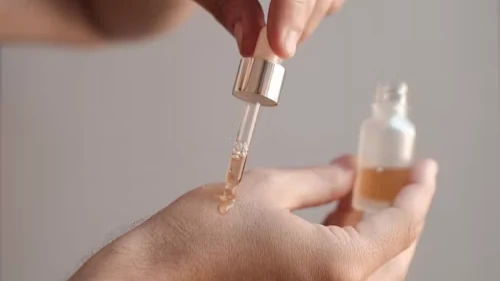
A ready formula comes from a factory’s library of market-validated recipes, some suppliers keeping 2,000+ on file and ready to produce. You choose an active story, such as vitamin C, retinol, hyaluronic acid, niacinamide, or a peptide complex, and launch under your label. This is the fastest route at the lowest MOQ, and it is where most first serums begin. Because the base may be shared with other brands, your edge comes from finish, claim, and packaging.
The Light Customization Route
Light customization starts from a mature formula and adjusts texture, finish, fragrance-free status, or the active blend to fit your positioning. You keep a proven stability backbone while making the product feel like your own, which suits a brand that wants distinction without a long rebuild. It runs on the same low MOQ tier as a ready formula in most cases.
The Fully Custom and Benchmark-Matched Route
A fully custom serum is engineered to your target claim and price point from a blank sheet. Benchmark matching is its own capability: you hand the lab a reference serum already selling in your market, and it reverse-analyzes and recreates or improves that product at a better cost. This is how brands build a signature hero without reinventing stability from scratch. See the ODM and custom formulation service for the full process.
Match a serum formula to your claim and budget
Tell us your target active, format, and market. We will confirm the right MOQ tier and scope a transparent, factory-direct quote.
Transparent MOQ Tiers for Liquid and Freeze-Dried Serum
Formula route and order volume decide your budget together. This section lays out the full MOQ ladder for both serum formats so you can self-qualify before you request a quote.
The Tier Table by Order Model
Most suppliers blur two very different products into one vague “low MOQ” claim. Liquid serum and freeze-dried serum scale differently, so a transparent factory quotes both. Here is the honest picture, tier by tier.
| Order Model | Liquid Serum MOQ | Freeze-Dried Serum MOQ |
|---|---|---|
| Light customization | from 1,000 unidades | from 2,000 pairs |
| White-label stock / semi-finished | from 3,000 unidades; bulk from 50 kg | from 30,000 pairs |
| Deep custom (own formula and packaging) | from 10,000 unidades | from 100,000 pairs |
Why Freeze-Dried Serum Is Quoted in Pairs
A freeze-dried “pair” is one vial of lyophilized powder plus its matching solvent or essence bottle, sold as a set. Freeze-drying locks a high-active formula in a stable dry state until the moment of use, which is why it commands a premium and a different MOQ unit than liquid serum. The distinction matters: a supplier who quotes “low MOQ” without naming the format and unit is quoting a number you cannot plan against.
If your brand story is potency and freshness, evaluate the freeze-dried and lyophilized range early. The everyday liquid lineup spans vitamin C, retinol, peptide, hyaluronic acid, niacinamide, and brightening complexes, collected under facial serum formulations.
Free Sampling: Test Before You Commit
The MOQ ladder tells you what you can order; a sample tells you whether you should. Here is how the free sampling process runs and how to judge what arrives.
The Four-Step Face Serum Sampling Process
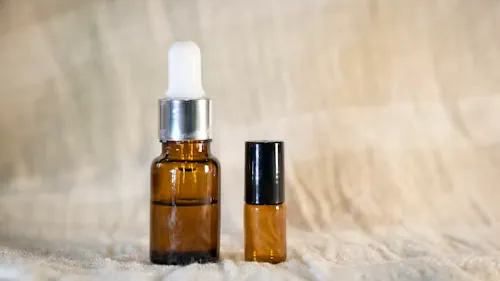
A serum sample lets buyers assess product performance before committing to a bulk order. Texture, absorption, stickiness, and fragrance all affect how the formula fits the target market, while stability and ingredient compatibility require separate technical evaluation. A structured sampling process helps identify formula issues early and reduces the risk of costly adjustments after production begins.
- Request bulk-formula samples. Ask for approximately three samples of the standard bulk formula. The buyer covers international shipping, while the samples themselves are provided free of charge, with no additional laboratory or raw-material fees.
- Evaluate the product experience. Test absorption speed, stickiness, layering compatibility, and fragrance. Compare the results against your target customer’s preferences and the product positioning.
- Request formula adjustments. A standard sample takes approximately 15 working days to prepare, while minor adjustments may be completed in as little as 7 working days. Confirm the expected turnaround time for each revision with the supplier.
- Approve the final formula in writing. Record the approved formula specifications before paying the bulk deposit. This gives both parties a clear reference for production and quality control.
Before sampling begins, confirm the supplier’s revision policy. Ask how many adjustment rounds are included, whether minor changes incur additional fees, and what happens if the bulk batch does not match the approved sample. These terms should be clear before the first production order.
How to Evaluate a Face Serum Sample
One practical tip from experienced buyers: evaluate the sample against a benchmark product your target customer already uses, not in isolation. If your serum has to beat a market-leading vitamin C on absorption and feel, test them side by side on the same day, and give the lab that feedback. Iteration grounded in a real comparison converges in far fewer rounds.
Embalagem, Actives Protection, and Compliance
Three decisions sit between an approved sample and a stable shipped product: the bottle, the stabilization method, and the market paperwork. Buyers who treat them as one checklist step avoid the most common launch failures.
Packaging as a Stability Decision
Packaging for a serum is a stability decision, not just a look. Match the bottle to what the active needs protection from:
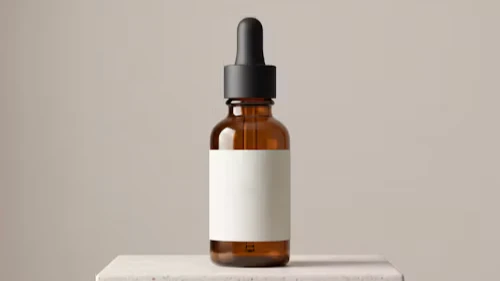
- Air and light: airless pumps, amber or opaque glass, and UV-blocking bottles for vitamin C and retinol.
- Freeze-dried formats: premium glass vials, commonly kept in stock for fast turnaround.
- ESG positioning: PCR recycled plastic, biodegradable substrates, and refillable designs for European and North American buyers.
Whatever the material, packaging should be compatibility-tested against the actual formula before a mold is committed, because a beautiful bottle that interacts with the contents turns into a warranty claim. Free structural design and 3D rendering are standard from serious OEMs; details sit on the packaging and design page.
Keeping Actives Alive to the Shelf
The single most common failure in a serum bulk order is an active that has already degraded by the time the product reaches your customer. Degradation is a chain: mixing introduces oxygen, filling leaves headspace, and a months-long sea freight cycle adds repeated heat-and-cold swings. Ask a supplier how each step is controlled rather than whether the formula “is stable”.
Real stabilization capabilities have names. Micro-encapsulation coats a fragile active so it releases gradually. Freeze-drying preserves high-activity formulas through liquid-nitrogen deep-freezing around -196°C and vacuum drying near -80°C. Segregated preservation keeps reactive components apart until use, and waterless bases concentrate actives instead of diluting them. Ask which of these run in-house, and request the extreme-stability testing that simulates cross-border freight. More is on the R&D and laboratory page.
Compliance Support for Your Markets
Serums are treated as cosmetics rather than drugs in most markets, so the compliance load is lighter than for sunscreen, but it is not zero. Ask a supplier to name its facility certifications: GMPC cleanroom production under ISO 22716 audited by a named third party, plus US FDA facility registration, with HALAL available for certain products.
On top of the certificates, factories support EU CPNP notification and Indonesia BPOM filing, and help assemble the paperwork for market entry. Claims still have to stay within cosmetic boundaries for each destination country, so confirm the wording with the supplier before you print labels, not after customs holds the shipment.
Cost Structure, Lead Time, and Your First-PO Timeline
Money and time are one plan. This section puts the two together: where a serum budget actually goes, when cash leaves your account, and how many weeks separate an approved brief from an EXW handover.
Where the Money Goes
A serum quote is built from three blocks: the formula, driven by the active and its concentration; the packaging, where a premium bottle and outer box can rival the formula in cost; and certification support where your market requires it. Quotes are factory-direct under EXW terms, so the number you approve carries no hidden logistics markup — freight and duties sit with your forwarder.
The cash requirement is staggered, not front-loaded. Sampling costs almost nothing up front — about three free bulk-formula samples with the buyer covering freight — then a 50% deposit opens production, and the final 50% falls due only after you inspect the finished goods. Larger programs, such as chain-retail orders, can settle by letter of credit.
Two traps inflate first orders. A false low-MOQ quote hides the format and unit, so a 1,000-unit claim can become 10,000 once details land. And the cheapest supplier saves cents per bottle while skipping stability controls — a trade that converts into warranty claims and a lost launch season.
The First-PO Timeline
Once the sample is approved, bulk production for general, in-stock packaging takes 15 para 20 days, and deep-custom packaging with private molds takes 30 para 40 days. Confirm the incoterm early, because EXW handover means you appoint your own forwarder and carry customs and freight from the factory gate.
| Stage | What Happens | Typical Time |
|---|---|---|
| Brief and route | Pick ready, light-custom, or custom; set active and MOQ tier | Days, depends on your brief |
| Amostragem | About 3 free bulk samples, freight on buyer, iterate to approval | 15 working days |
| Embalagem | Projeto, 3D render, compatibility and airless/UV test | Runs parallel |
| Bulk production | 50% deposit, cleanroom filling, in-process QC | 15-20 or 30-40 days |
| Inspection and delivery | You inspect, pay 50% balance, EXW handover to your forwarder | At completion |
Plan the launch date backward from that table, not from a marketing calendar. The two variables that move most are sample iteration count and packaging depth, so lock the formula first and let packaging run in parallel.
Budget the cash the same way. The deposit is due when production opens, and the balance only after your inspection, so your working capital requirement is staggered rather than front-loaded. Add the freight cost your forwarder quotes, since EXW terms leave logistics with you, and the landed cost per bottle is complete.
Launch Your Hero Serum with Confidence
A strong private label face serum launch starts with a proven formula, transparent MOQ terms, and reliable active ingredient stability. Before placing your first order, compare formula options, review samples, and confirm production costs and lead times with your supplier.
Elemento provides transparent MOQ tiers for both liquid and freeze-dried serums, free bulk samples, and in-house formulation and stabilization support. Start Your Project to discuss your formula requirements and first production order.
Frequently Asked Questions
What is the MOQ for private-label face serum?
Liquid serum starts at 1,000 units for light customization, 3,000 units for white-label stock, and 10,000 units for a fully custom formula with your own packaging. Freeze-dried serum starts at 2,000 pairs, with semi-finished liquid bulk from 50 kg.
How much does it cost to launch a serum brand?
Cost is driven by the active and its concentration, the packaging, and your market’s certification needs, so it is quoted on inquiry rather than listed. The trial stays cheap because samples are typically free and you pay only the freight; under EXW terms, freight and duties sit with your forwarder.
Are free serum samples really available?
Yes. Reputable OEMs provide about three free bulk-formula samples and the buyer covers only international shipping. Formula tweaks usually stay free until the product is approved.
How long does it take to launch a private label serum?
A standard sample takes about 15 working days, and bulk production runs 15 para 20 days with general packaging or 30 para 40 days with deep-custom packaging. From approved brief to EXW handover, plan roughly six to ten weeks.
Private label or custom formulation — which should I start with?
Private label applies your branding to a market-validated formula at the lowest MOQ and the fastest speed. Custom formulation engineers an exclusive recipe around your claim and price point, and benchmark matching recreates a proven reference product at a better cost. Many brands launch private label first, then move hero SKUs to exclusive formulas.
Can I launch a freeze-dried serum with low MOQ?
Yes. A freeze-dried serum starts at 2,000 pairs under light customization, so you can launch a premium, high-stability format without committing to a mass production run.


